The Industry Knowledge About Ceramic Film, Nano-Ceramic and Magnetron Window Films
In recent years, modern office spaces have increasingly tended to adopt large windows, glass curtain walls, and open work areas with natural lighting. However, while bringing aesthetic and design advantages, this also means that the office environment will face stronger direct sunlight, higher indoor temperatures, harmful ultraviolet radiation, and place a heavy burden on the HVAC system.
An efficient and common solution is installing a specialized solar control window films for windows which reduces heat and radiation without compromising natural light. In this article we review three main technologies: Ceramic window film, Nano-ceramic film and Magnetron window film– and compare them in depth.
Overview of Solar Window Films Technologies
Solar window films serve as a smart protective layer designed to reduce heat, UV exposure and glare in office spaces. They are applied to the interior side of the glass discreetly and aesthetically and provide a significant functional improvement without disturbing the original design.
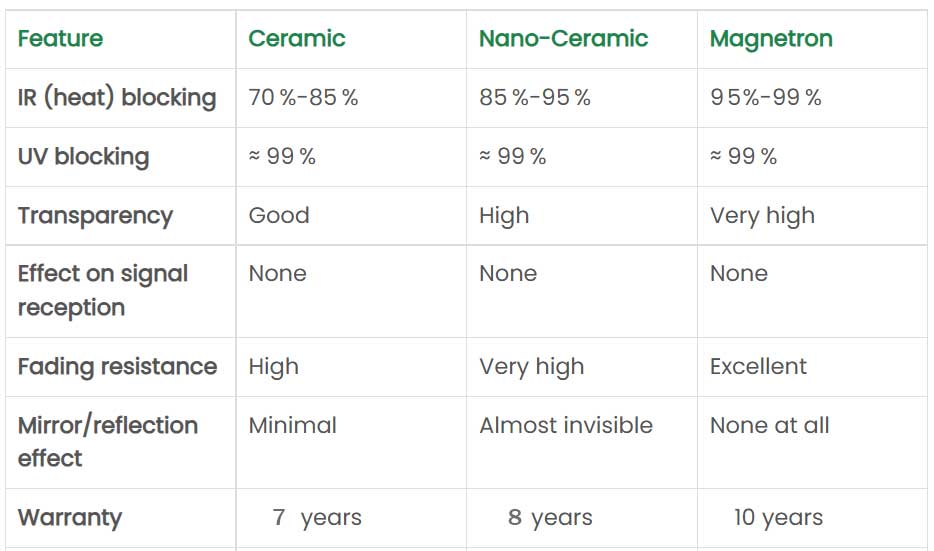
Ceramic Window Tints: based on microscopic ceramic particles, contains no metals, is non-reflective, and does not interfere with communication signals. Blocks about 70-85% of infrared (IR) rays, and around 99% of UV radiation.
Nano-Ceramic Window Films: an enhanced version of ceramic, with smaller particles at higher density. Allows natural light while offering higher heat blockage – up to 90%-95% IR. Offers very high transparency, long-term durability, and does not fade.
Magnetron Window Films: the most advanced technology currently, based on a multi-layer coating using magnetron (sputtering) in a vacuum chamber. Provides heat blockage up to 99% IR, high optical transparency, extreme durability over many years – at a higher price.
Comparison ‒ Ceramic, Nano-Ceramic and Magnetron Window Tinting Films
Advantages and Disadvantages of Magnetron Window Film Compared to Nano-Ceramic Tint
Advantages:
√ Very high optical transparency – almost invisible to the eye.
√ Maximum heat blockage – up to 99% of infrared radiation.
√ Does not fade, yellow or lose clarity over time.
√ Non-reflective – maintains the natural appearance of the glass.
√ Does not interfere with cellular, GPS or WiFi signals.
Disadvantages:
Higher cost due to advanced technology. Usually requires precise professional installation.
Summary
In offices with significant sun exposure – whether through windows, curtain walls or glass partitions – installing a high-quality film is a smart decision that brings comfort, energy savings and improves appearance and atmosphere.
The choice between ceramic, nano-ceramic or magnetron window tint depends on the needed performance level, light exposure, and budgetary constraints. With warranties up to 10 years this is a long-term investment that proves itself quickly.